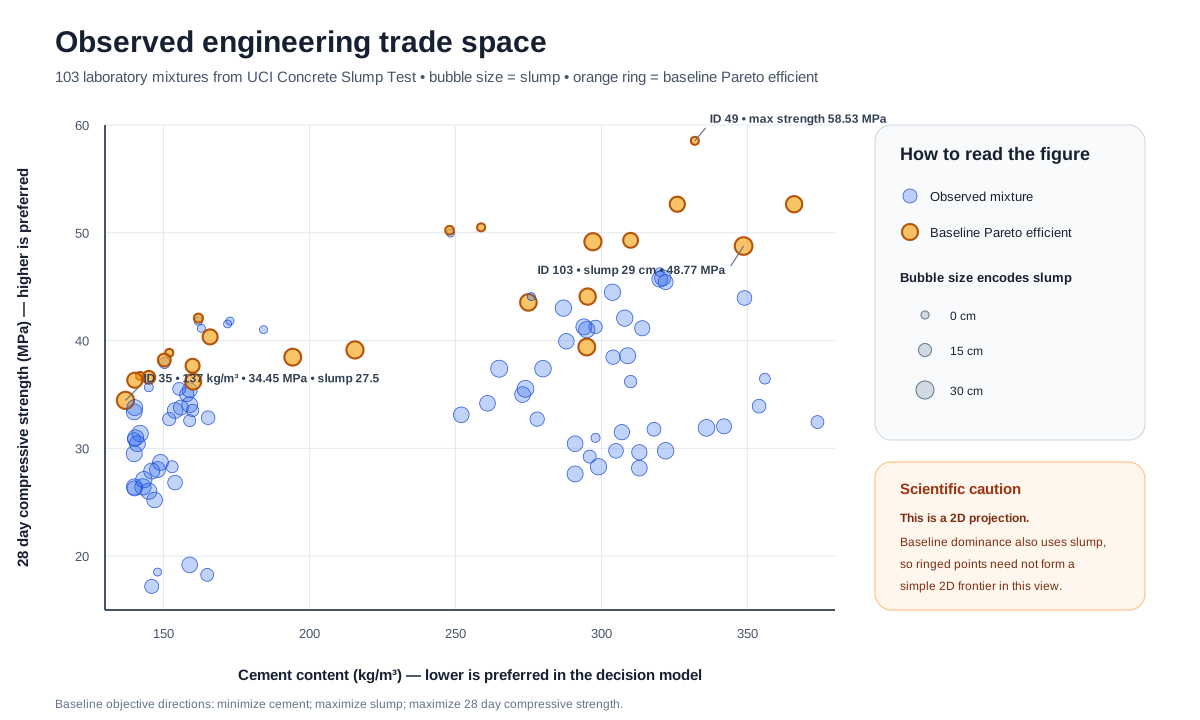
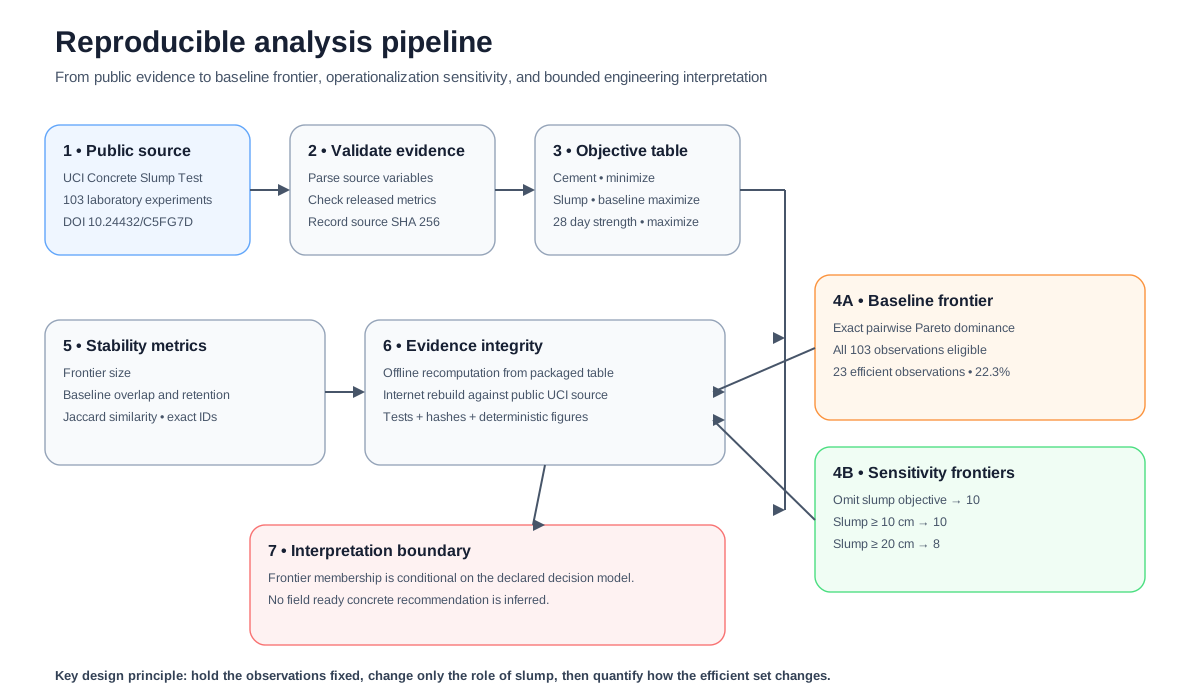
Using 103 observed concrete mixture experiments, the analysis treats the laboratory observations as a systems engineering trade space. Pareto efficient alternatives are identified across cement use, slump and 28 day compressive strength.
A second formulation removes slump from the objective set and then treats it as an eligibility threshold. Comparing the resulting Pareto sets shows how strongly the engineering decision space depends on the definition of requirements.
Data source: UCI Concrete Slump Test, 103 laboratory mixture experiments, DOI 10.24432/C5FG7D.
Scientific system overviewData processing and empirical workflow
Systems Engineering
Requirements Classification Evidence Triage on a Gold Standard Benchmark
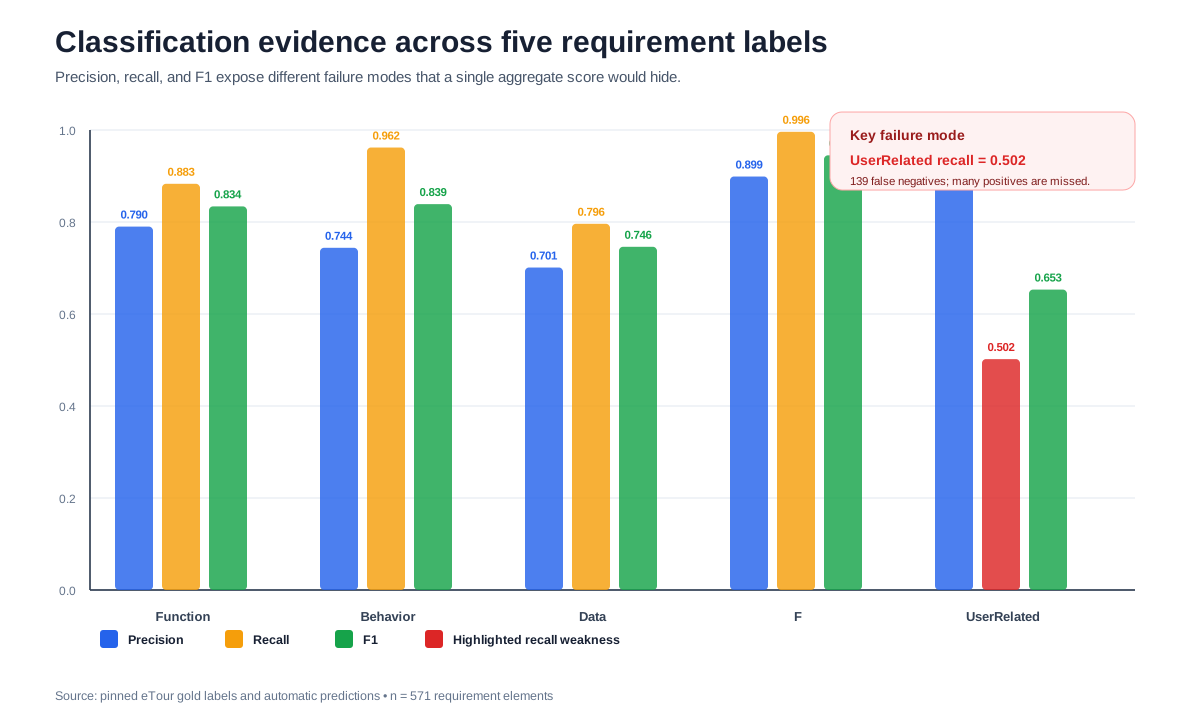
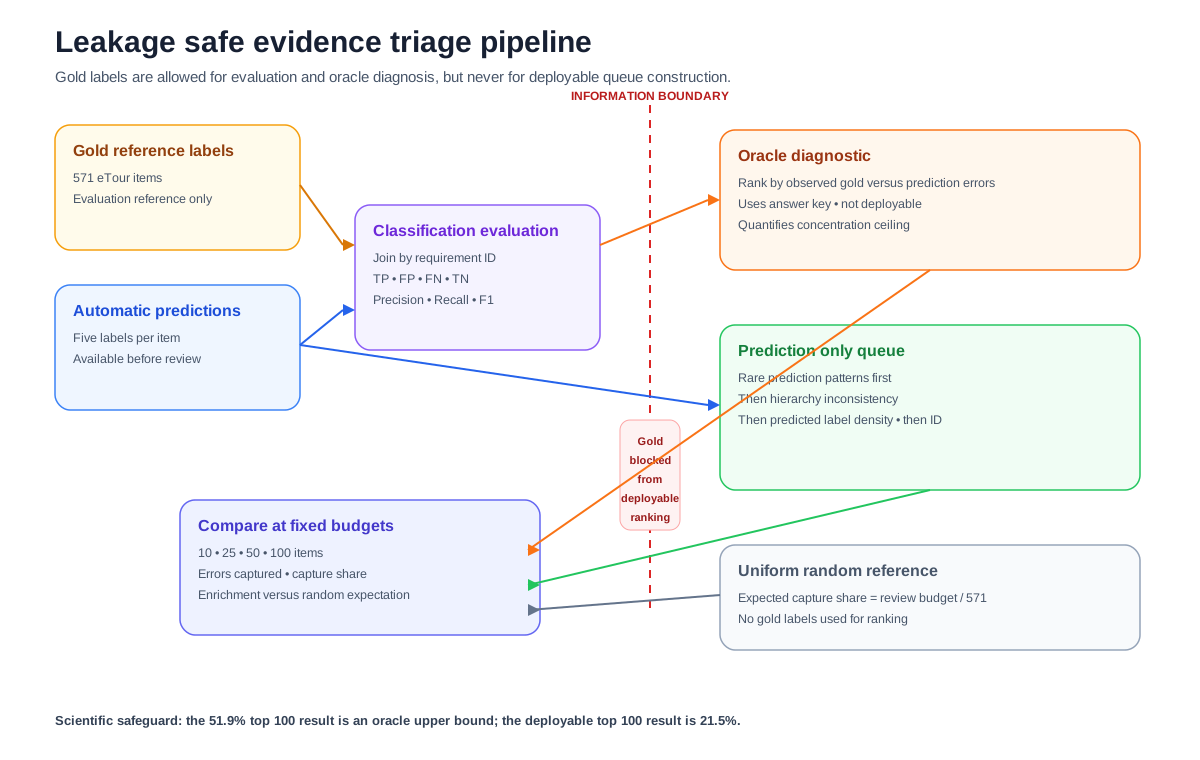
The requirements classification analysis uses 571 eTour requirement elements and evaluates fine grained classification performance. It also examines how limited human review effort could be allocated when errors are unevenly distributed across requirement categories.
Gold labels are used only for retrospective diagnosis and to define an oracle ceiling. The operational review queue is ranked from model outputs without access to the answer key. The comparison quantifies both the potential value of targeted review and the gap between retrospective error knowledge and a deployable triage procedure.
Data source: eTour gold standard requirements benchmark and pinned NoRBERT/FTLR replication artifacts hosted through Zenodo.
NASA capacity trajectories and monitoring checkpointsFixed checkpoint forecasting and evaluation workflow
Systems Engineering
Forecast Maturity of Technical Performance Margin on NASA Lithium Ion Battery Aging Data
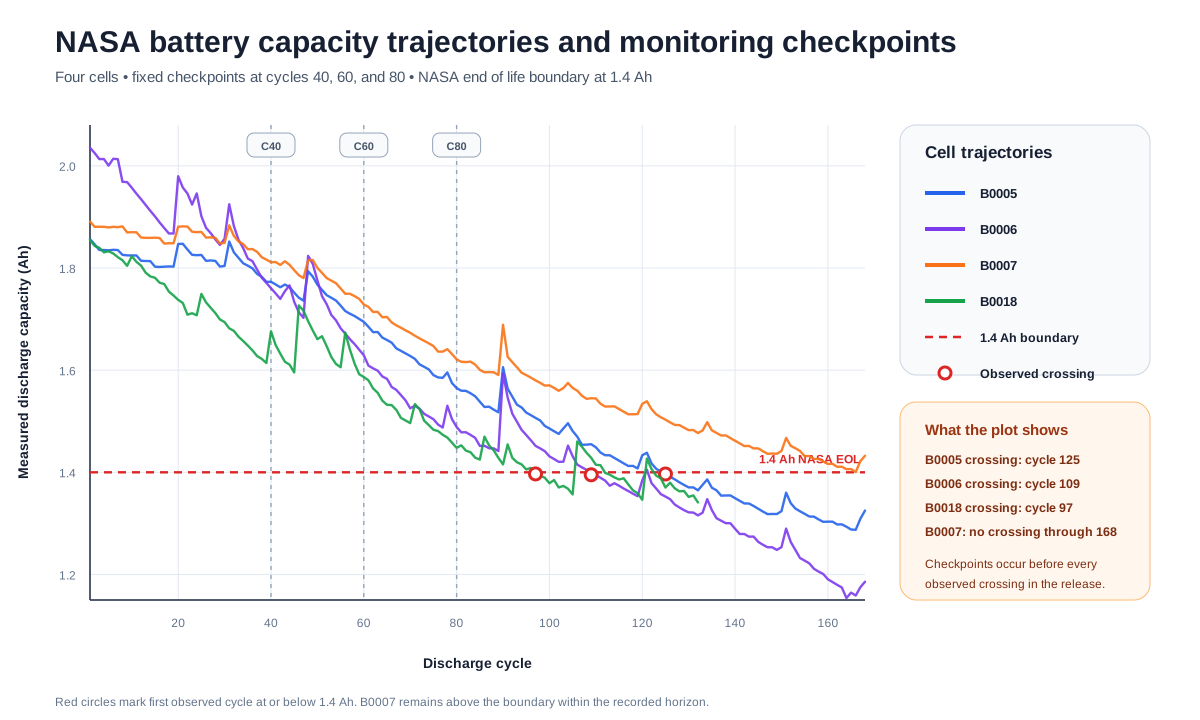
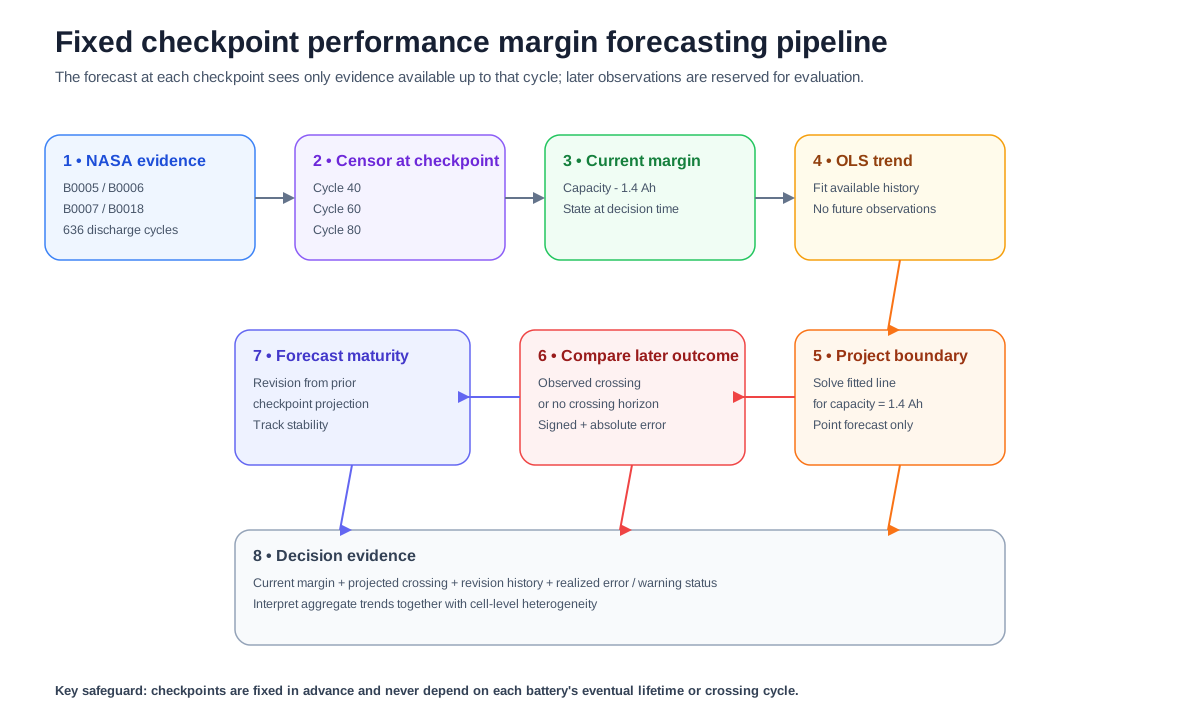
Four NASA lithium ion battery trajectories are evaluated at fixed cycle checkpoints to study the maturity of technical performance margin forecasts. Each forecast is restricted to information available at the corresponding checkpoint, preserving the temporal conditions of an actual engineering decision.
At each checkpoint, the analysis records current capacity margin, projected crossing of NASA’s 1.4 Ah end of life criterion, subsequent forecast revision and realized forecast error. Aggregate error declines as evidence accumulates, but behavior differs across cells and one battery produces an early false warning. Forecast stability therefore becomes part of the evidence used to judge decision readiness.
Data source: NASA Prognostics Center of Excellence Lithium Ion Battery Data Set, using cells B0005, B0006, B0007, and B0018.
Cross project maintenance intent compositionHeterogeneity analysis and diagnostic workflow
Systems Engineering
Cross Project Heterogeneity in Quality Oriented Engineering Change
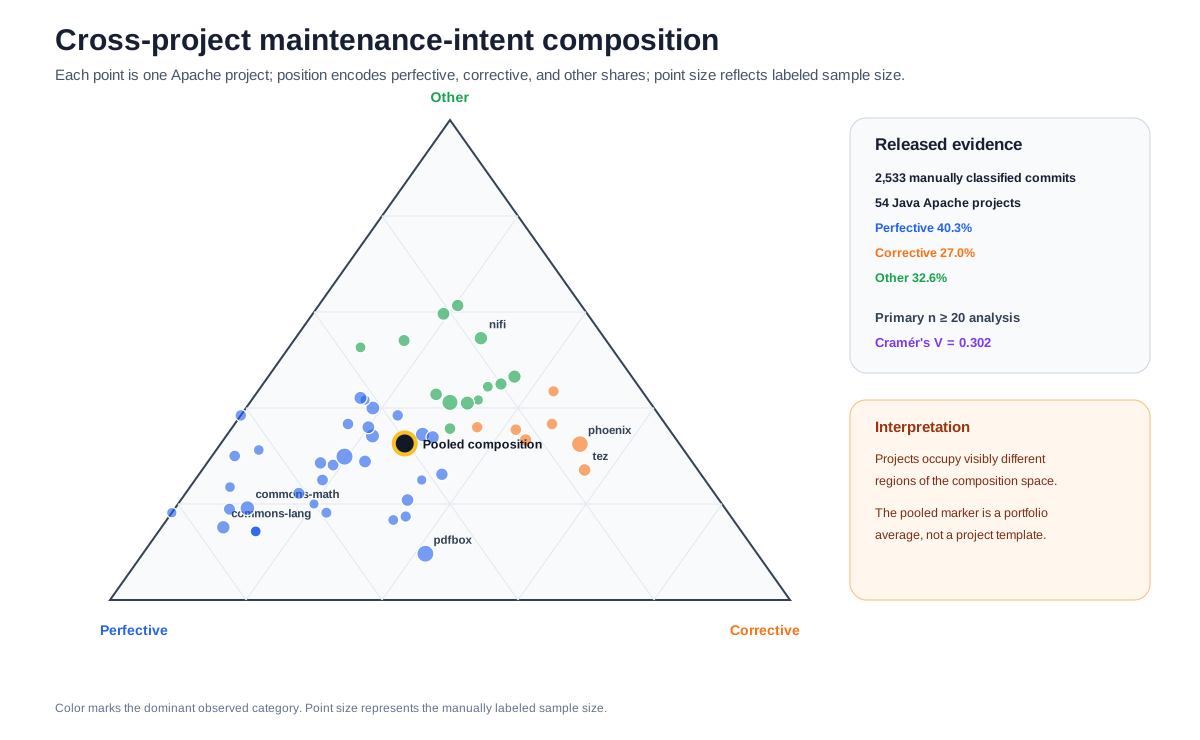
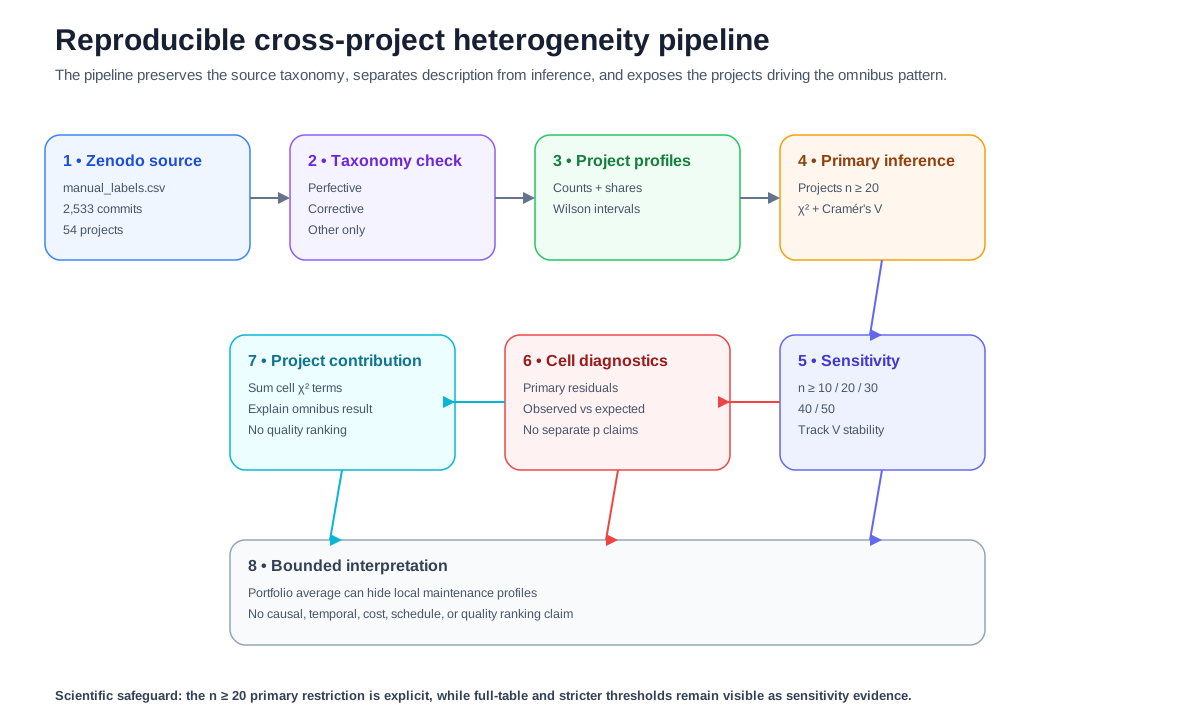
The analysis reexamines 2,533 manually classified commits from 54 Apache Java projects to determine whether a pooled maintenance profile represents individual software systems adequately. Each project is characterized by its observed proportions of perfective, corrective and other maintenance intent, together with uncertainty at the project level.
Cross project heterogeneity is quantified, tested again after progressively removing small project samples and decomposed into the project and category combinations contributing most strongly to the overall statistic. The results show that a pooled portfolio average can conceal substantial differences among individual project maintenance profiles.
Data source: Trautsch, Erbel, Herbold & Grabowski replication dataset on Zenodo, DOI 10.5281/zenodo.7078179.